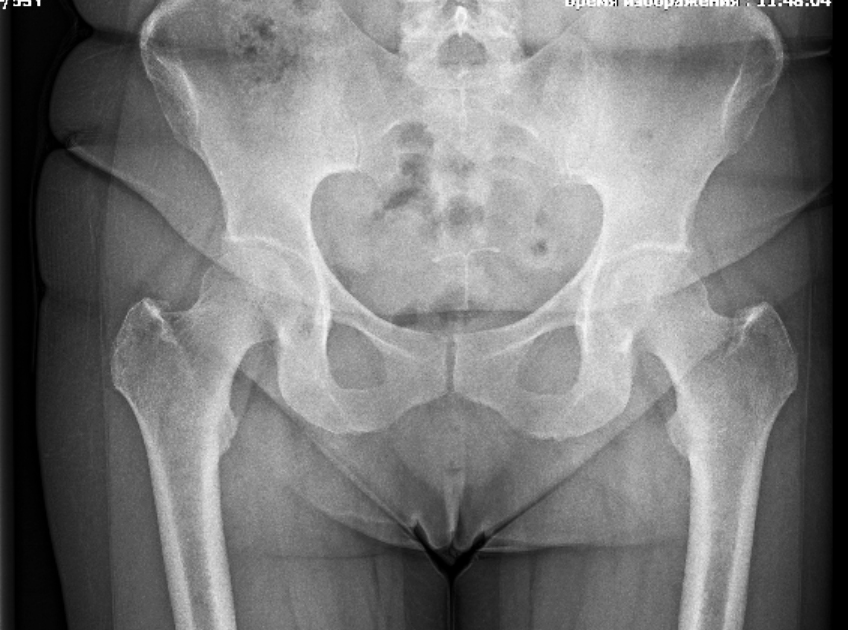
Osteoarthritis of the hip joint (coxarthrosis) is a chronic, progressive disease of the hip joint based on degenerative-dystrophic changes in the joint tissues. These changes lead to the destruction of articular cartilage and the underlying subchondral bone, deformation of joint surfaces, impairment of joint function, severe pain in the joint region, and a substantial reduction in the patient's quality of life.
The disease develops gradually. Initially, the patient is troubled by minor, periodic pain that can be localized in the inguinal region, the greater trochanter area (the lateral surface of the hip joint), the gluteal and sacral regions, and along the lateral surface of the entire thigh. The pain appears during prolonged walking and frequently migrates: one day the pain is in the inguinal region, the next day in the gluteal or sacral region, and the day after that it may be localized along the entire lateral surface of the thigh. This migration of pain masks the onset of hip osteoarthritis.
Patients frequently attribute the pain to osteochondrosis of the lumbosacral spine and seek help from a neurologist. There is no fundamental difference in the pharmacological management of osteochondrosis and hip osteoarthritis. In both osteochondrosis and hip osteoarthritis, analgesic nonsteroidal anti-inflammatory drugs (NSAIDs), chondroprotectants, and muscle relaxants are prescribed. Therefore, for a certain period, treatment by a neurologist yields a positive effect. However, over time, the pain becomes more clearly localized in the hip joint region, and the patient is referred to an orthopedic trauma specialist, who establishes the diagnosis of hip osteoarthritis. In addition to the ongoing treatment, the patient is prescribed intra-articular injections of hyaluronic acid, PRP therapy, therapeutic exercise, kinesioterapy, and physiotherapy.
However, throughout my entire medical practice, I have never encountered a single patient in whom conservative treatment successfully cured hip osteoarthritis. Yes, for a certain period, the patients' pain decreased or even completely disappeared, and their quality of life improved. But sooner or later, the joint pain recurred, and ultimately, everything culminated in total hip arthroplasty (replacing one's native joint with an artificial one).
While replacing a diseased joint with an artificial one eases the patient's life, eliminates pain, and improves joint mobility, there are two major "BUTs". The first is a series of lifelong restrictions for the patient regarding their lifestyle and physical activity. The second is that sooner or later, the hip prosthesis will need to be replaced with another one, which is a more complex and expensive surgical procedure during which the rate of postoperative complications increases more than twofold.
Information can be found on the internet stating that prosthesis replacement is required after 15–25 years. However, in real life, the necessity to revise a primary prosthesis arises much earlier, approximately after 7–10 years. This is not due to the wear of the prosthesis components themselves, but rather due to the development of instability of the prosthetic components interfacing with bone tissue (the stem and the cup of the prosthesis). The latter occurs because the bone tissue surrounding the metallic components of the prosthesis undergoes lysis (resorption), leading to micromotion of the prosthesis within the bone. Over time, the mobility of the prosthetic components increases, creating the need for its revision. This process occurs particularly fast in young patients who lead an active lifestyle.
Orthopedists worldwide are unanimous in their opinion that total hip arthroplasty is a dead-end direction that has completely exhausted itself. Searches for novel methods to treat hip osteoarthritis are required so that the issue of endoprosthetics arises extremely rarely, or at least not before the patient reaches 65–70 years of age.
According to modern standards for treating hip osteoarthritis, conservative treatment (pharmacotherapy, physiotherapy, and therapeutic exercise) is conducted during stages 1–2 of the disease, while total joint replacement is performed during stages 3–4. That is, the standards themselves indicate that this treatment does not affect the osteoarthritic processes and is palliative. The goal of such treatment is not to cure the disease, but to maximally alleviate pain, relieve painful symptoms, and, if possible, improve the patient's quality of life until the joint is replaced with an artificial one.
The question arises: "Can nothing be done, and is joint replacement unavoidable?". Of course, something can be done. And it is entirely possible to preserve one's native joint.
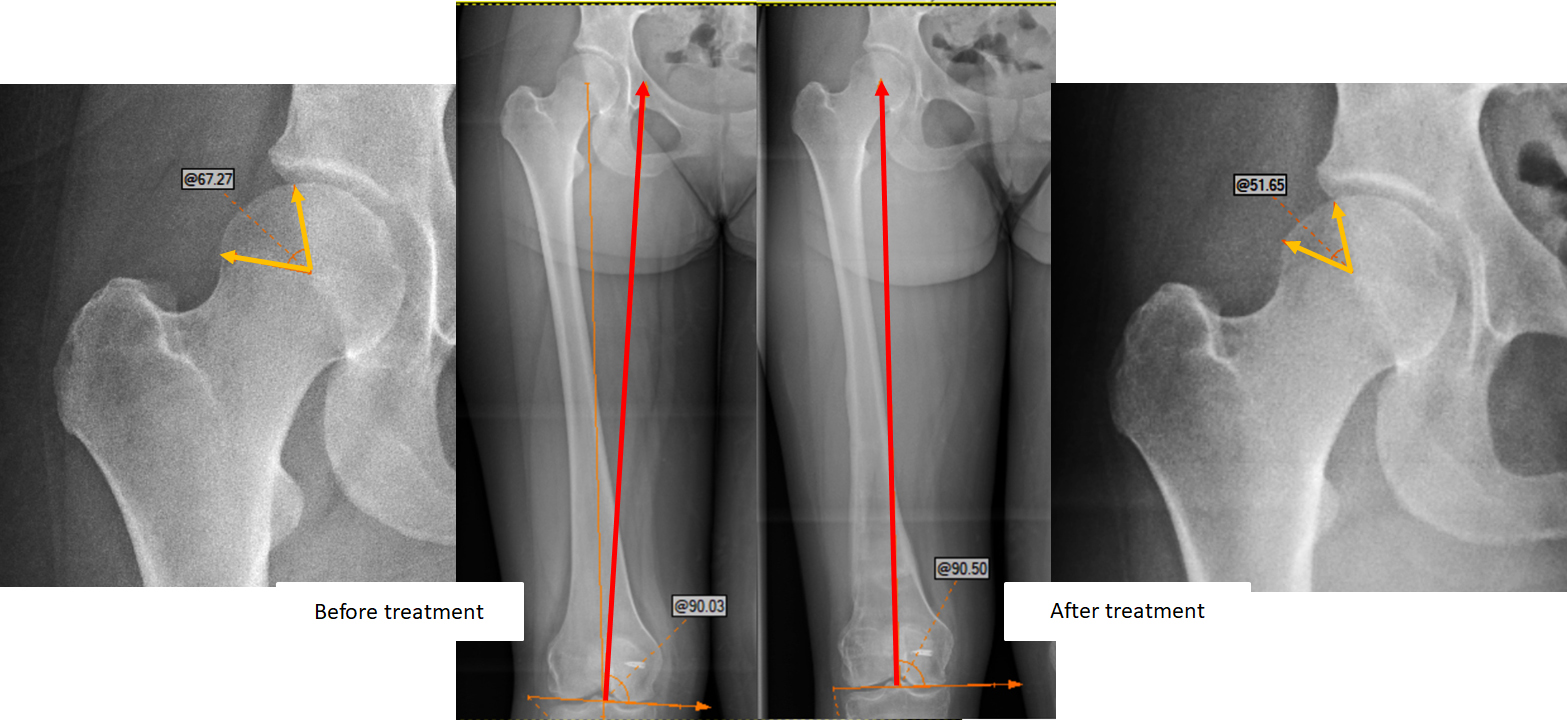
Our studies have demonstrated that the earliest signs of hip osteoarthritis begin to develop not inside the joint itself, but within the joint capsule and the tissues surrounding the joint. The primary cause of these tissue changes is an abnormal axial load on the femur. Normally, the mechanical load axis of the femur runs from the center of the knee joint to the center of the femoral head. If the force generated during walking is directed along this axis, no additional forces arise in the region of the joint capsule and surrounding tissues. The joint remains in a balanced state, and the load on the femoral head is distributed evenly.
In cases where the force acting during walking deviates medially from the load axis (in the direction of the pubic symphysis), forces arise in the femoral head region that tend to subluxate the head laterally. These forces cause the joint capsule to remain in a hyperextended state.
The compensation for these forces that tend to subluxate the head is achieved by the gluteal muscles, the obturator muscles, and the piriformis muscle. During walking, these muscles are constantly in a state of overstrain to maintain the femoral head in the correct position. Therefore, practically all patients note that the initial pain they experienced was located in the gluteal region and the sacral region, where the aforementioned muscles attach. Persistent overstrain of the capsule and muscles leads to a deterioration of blood circulation in the hip joint region and alters metabolic processes. These changes indirectly begin to affect the metabolic processes inside the joint.
However, the compensatory capacities of the joint capsule and muscles are not limitless. Microtears appear within the joint capsule and muscles; consequently, the strength of the joint capsule decreases, and the muscles lose their strength. Because of this, the femoral head gradually begins to shift laterally, and an area subjected to excessive loads appears on its superolateral surface. In this area, pathological changes begin in the articular cartilage, and the osteoarthritic process shifts directly into the joint.
In cases where the force acting during walking deviates laterally from the load axis toward the greater trochanter of the femur, forces arise in the femoral head region that tend to "impinge" or force the femoral head into the articular surface of the pelvis. As a result, the entire superomedial surface of the head experiences overloading, leading to changes in the articular cartilage and the progression of hip osteoarthritis. Unfortunately, there are no compensatory mechanisms available in this situation. Therefore, in patients with such a lateral deviation of the acting force from the load axis, the progression of hip osteoarthritis occurs significantly faster than in patients with a medial deviation of the acting force.
What is the cause of the acting force deviating to one side or the other from the femoral load axis? It is entirely related to the position of the distal (knee) articular end of the femur. If the plane of this knee end of the femur deviates laterally, the acting force deviates medially from the axial load line of the femur. If this plane deviates medially, the acting force correspondingly deviates laterally from the load axis. Therefore, the primary cause of hip osteoarthritis development should be considered a deformity (deviation) of the distal knee articular end of the femur, which leads to abnormal loading on the hip joint and promotes the development of osteoarthritis in this joint.
This statement does not align with generally accepted information regarding the primary causes of hip osteoarthritis development. Such causes typically include excessive joint loading, congenital joint abnormalities, impaired blood supply and metabolic disorders within the joint, inflammatory joint diseases (arthritis), and others. However, these should be viewed not as root causes, but as risk factors that increase the probability of developing hip osteoarthritis and influence its progression.
We have developed a technology for the surgical correction of the position of the distal (knee) articular end of the femur. To perform this surgery, a specialized set of surgical instruments was designed and patented, allowing for a highly precise correction of the position of the distal knee end of the femur.
In all patients who presented to our clinic with pain in the hip joint region, examinations revealed a deviation of the acting force from the femoral load axis, which was associated with a deformity of the distal knee articular end of the femur. Following surgical correction of the position of the distal knee end of the femur, the pain in the hip joint region disappeared in all patients, enabling them to lead an active lifestyle.
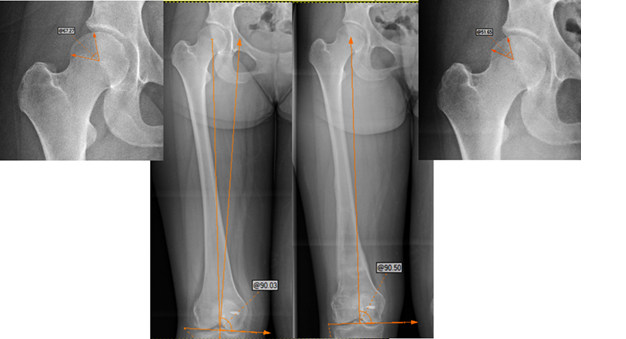
Image Description: The figure demonstrates that prior to surgery, the acting force is shifted medially from the femoral load axis, and the femoral head is in a state of subluxation (left side of the figure); postoperatively, the acting force is directed along the axial load line of the femur, and the head is in its correct anatomical position.
It must be noted that this surgery is effective during stages 1 and 2 of the disease. At these stages, especially in young patients, this surgery establishes the conditions required for the reversal of hip osteoarthritis. In the so-called transitional stage 2–3 (between stages 2 and 3), the probability of reversing osteoarthritic changes decreases significantly, but performing the corrective surgery halts the progression of the disease and allows patients to preserve their native hip joint.
Clinical cases
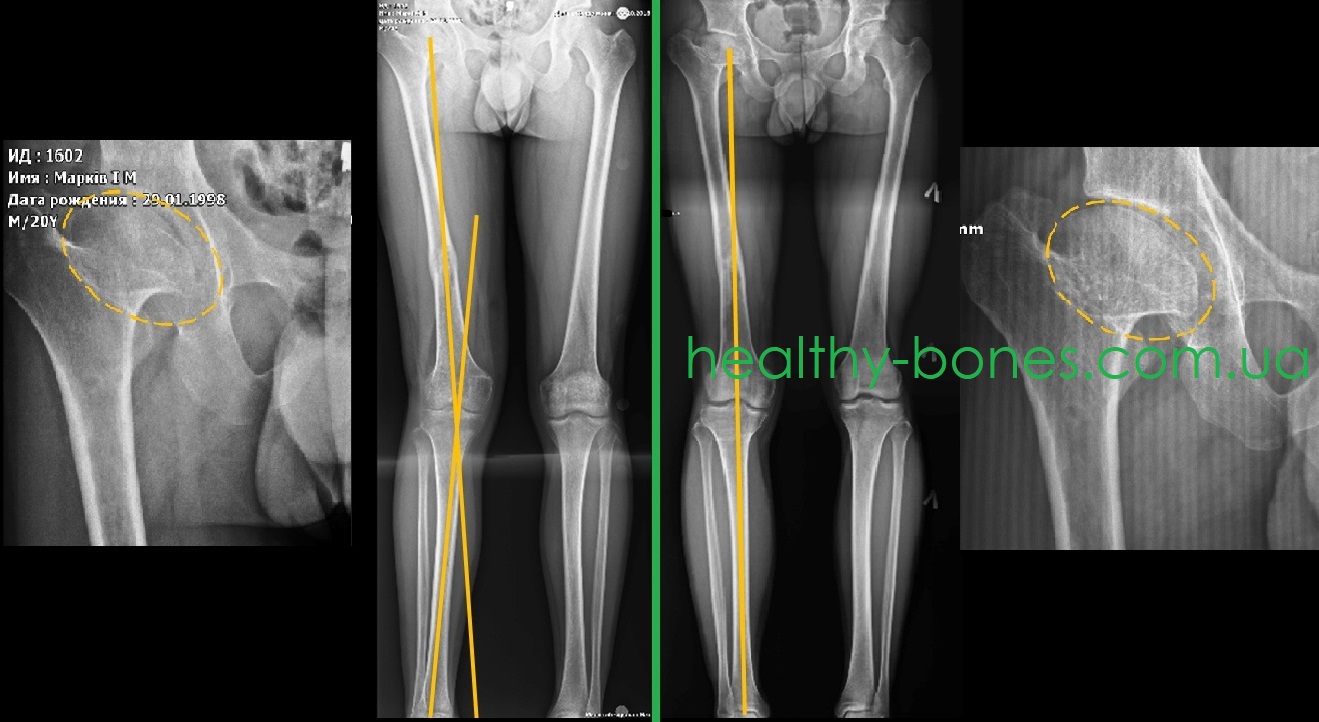
The guy turned came to us with complaints of pain in the right hip joint and severe lameness in the right leg.
There is a history of dysplasia of the right hip joint. At the age of eighteen, he was offered to undergo prosthetic replacement of the right hip joint. But on the day when the operation was planned, the doctor recommended not to have a joint replacement, but to look for alternative methods of treatment (a recommendation worthy of respect).
During our examination we found:
- significant shortening of the neck of the right femur with mushroom-shaped deformation of the head, neck-diaphyseal angle within 130°
- shortening of the right lower limb up to 5 cm
- valgus deformity of the leg.
We carried out staged surgical treatment - at the first stage, the right femur was lengthened, and at the second stage, the valgus deformity of the tibia was eliminated.
These operations made it possible to restore the axial load of the right lower limb as much as possible, which made it possible to eliminate pain in the area of the right hip joint. After completion of treatment, the head of the femur became more rounded, which contributed to an increase in the range of motion in the joint.
Currently (two years after completion of treatment) the patient walks without lameness, there is no pain in the area of the right hip joint, he feels like a full-fledged person. He works as an administrator and spends almost all day on his feet.
A 36-year-old female patient, Kateryna, presented to the medical center presenting with complaints of significant pain in the right hip joint that occurs during walking. The initial joint pain appeared approximately one year ago, after she walked a distance of about 12 km (Kateryna is very fond of walking). On the following morning, she was not bothered by any joint pain. However, after she walked approximately 2 km, the pain recurred. She sought assistance from an orthopedic trauma specialist, who established a diagnosis of osteoarthritis of the right hip joint, prescribed analgesics and chondroprotectants, and recommended reducing the load on her right leg. Nevertheless, the treatment yielded no clinical results, and Kateryna was informed that she would most likely require total right hip arthroplasty within the upcoming year. Kateryna categorically refused to undergo this surgery, which is why she sought our consultation.
Objective examination revealed initial manifestations of osteoarthritis of the right hip joint and a deformity of the knee articular end of the right femur, with a medial deviation of the articular surface plane. Consequently, the mechanical force generated during walking deviated laterally away from the axial load line of the femur, which directly disrupted the load distribution on the femoral head and caused the head to be, as it were, "impinged" or forced into the articular surface of the pelvic bone. These pathological changes were the root cause of the development of the hip joint osteoarthritis and induced the joint pain during walking.
The patient underwent a corrective surgical procedure, as a result of which the mechanical force acting on the femur was realigned along the axial load line, and the force that was "impinging" the head into the articular surface of the pelvic bone resolved.
Six months postoperatively, once full weight-bearing on the right lower extremity was permitted, she reported a complete absence of pain in the joint area.
Two years following the surgery, Kateryna leads an active lifestyle. According to her, she allows herself to go on walking trips of 4–5 km and does not feel her right hip joint at all.
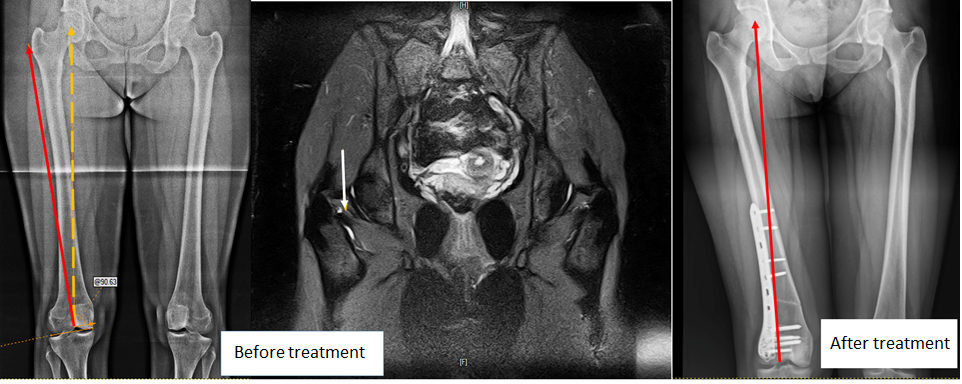
A 29-year-old female patient, Olena, presented with complaints of pain in the region of the right hip joint, the lateral surface of the right thigh, the right buttock, and the sacrum, which occur during walking. The pain in the thigh and gluteal region first appeared approximately 3 years ago after she went on a long walking tour in the mountains (she is very fond of walking). Initially, she consulted a neurologist, who treated her for lumbosacral radiculitis and trochanteritis. For a certain period, the pain disappeared, but after she needed to walk approximately 3 km, the pain in the thigh and buttock recurred, and pain in the hip joint appeared. She was consulted by an orthopedic trauma specialist, who established a diagnosis of "initial manifestations of osteoarthritis of the right hip joint," prescribed analgesics, and recommended reducing her walking distance to 1 km. While the patient was taking the pain medications, she was not bothered by pain, but as soon as she stopped taking the analgesics, the pain recurred and became more localized in the hip joint region.
Objective examination revealed initial manifestations of osteoarthritis of the right hip joint and a deformity of the knee articular end of the right femur, with a lateral deviation of the articular surface plane. Consequently, the mechanical force generated during walking deviated medially away from the axial load line of the femur, which promoted lateral subluxation of the femoral head and overloaded the joint capsule and gluteal muscles. This was the root cause of the development of the hip joint osteoarthritis and the pain syndrome.
The patient underwent a corrective surgical procedure, which normalized the load distribution on the femur.
Six months postoperatively, once full weight-bearing on the right lower extremity was permitted, she reported a complete absence of pain in the joint area. Currently, the patient leads an active lifestyle and has resumed her favorite habit of long-distance walking. She is no longer bothered by any pain in the right hip joint. According to her, she does not feel her right hip joint at all.