
FAQ
During the initial consultation, patients with joint arthrosis often ask me the following questions:
Yes, of course, stem cells can be used in the treatment of arthrosis. But it is important to understand that a stem cell is not a cure-all for arthrosis. Stem cells do have enormous regenerative potential, and they are able to restore damaged hyaline cartilage. However, if the cause of the arthrosis has not been eliminated, the joint cartilage restored by the stem cells will be damaged again and everything will return to its previous state. Therefore, before introducing stem cells into the joint cavity, it is necessary to eliminate the cause of the arthrosis — only then can a maximum and lasting result be achieved from the action of the stem cells.
Usually, after the operation the patient stays in the hospital for 2-3 days, after which they are discharged for outpatient treatment at their place of residence under the supervision of a traumatologist or a clinic surgeon. But I am always in touch, and if the patient has any questions, they can always contact me.
The duration of rehabilitation depends on several factors: the area in which the corrective operation is performed, the patient's age, the patient's individual characteristics, and the presence of concomitant diseases.
If the correction of the load axis is carried out in the area of the tibia, the rehabilitation period lasts approximately 4-6 months. When a corrective operation is performed in the area of the femur, the rehabilitation period lasts approximately 6-8 months.
The duration of the rehabilitation period depends on the time it takes for the bone fragments to fuse. In young people, fusion occurs faster than in older patients. The function of the thyroid gland has a significant impact on the duration of fusion. Even a slight deviation in thyroid function indicators can slow down the process of bone fragment fusion. Therefore, during preoperative preparation, I recommend that patients check their thyroid hormones, and if any deviations are detected, the patient corrects the thyroid function with an endocrinologist before proceeding with surgical treatment.
The patient's dietary preferences have an important impact on bone fusion. Therefore, during treatment I recommend following a certain diet.
But, first and foremost, the patient themselves has a significant impact on the rehabilitation process. I tell each of my patients that the result of treatment depends 50% on the surgeon and 50% on the patient. During the operation, the surgeon creates the conditions necessary for the restoration of the joint, and the patient, by strictly following the recommendations given to them, ensures that these conditions are met.
There are several causes of curvature (deformation) of the joint surfaces of the tibia and femur. In my conviction, all bone deformities are laid down in childhood and adolescence, when active growth and bone formation take place.
In childhood, when a child begins to walk, the first load on the child's legs goes through the feet. Therefore, the distribution of the force acting on the leg bones and the formation of the joint surfaces of the knee and ankle joints depend on how the foot is formed and, above all, on the position in which the calcaneus (heel bone) is formed. If the calcaneus is formed correctly, the axis of its load coincides with the mechanical axis of the leg and the load axes of the shin and thigh. In this case, the direction of the acting force coincides with all the axes of the leg. In this situation, the joint surfaces of the ankle and knee joints are formed perpendicular to the load axes of the limb segments.
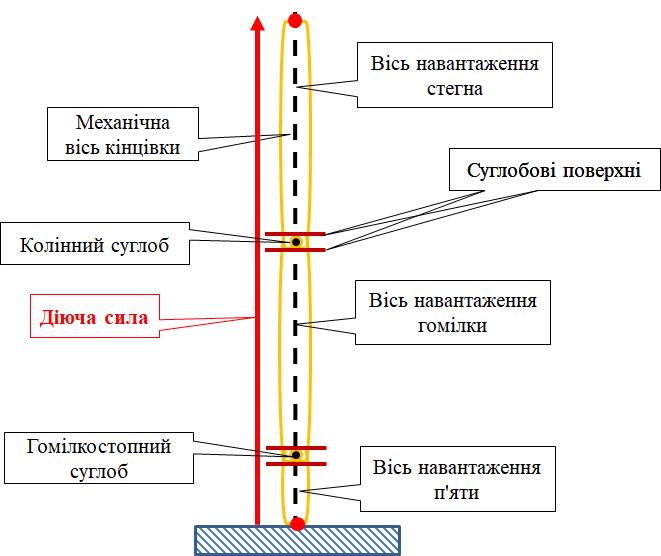
If during formation the calcaneus deviates outward or inward from the mechanical axis of the leg, the load axes of the heel, shin and thigh deviate from the mechanical load axis of the leg, as shown in the figure.
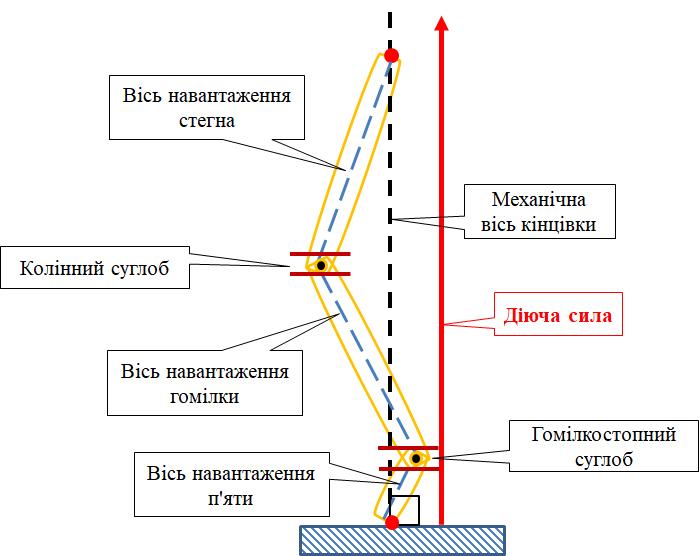
According to the laws of physics, the formation of the joint surfaces of the ankle and knee joints occurs perpendicular to the acting force. Since the load axes of the segments do not coincide with the direction of the acting force and the mechanical axis, the joint surfaces are formed at an angle to the load axis of the leg segments. As a result, curvature (deformation) of the joint surfaces of the tibia and femur occurs.
A manifestation of the incorrect formation of the position of the calcaneus is flat feet. The more pronounced the deviation of the calcaneus, the more pronounced the flat feet.
The next cause of curvature (deformation) of the joint surfaces of the lower limbs is associated with the active life that a person leads in adolescence – running, jumping, and various sports. At this age, limb injuries occur very often. These injuries are not necessarily associated with bone fractures. Very often, when falling or jumping from a height, the so-called bone growth zone is injured. In some people these injuries pass without a trace, while in others, as a result of injuries to the growth zone, the growth rate of the bone slows down in one of the areas of this zone. Most often, this slowdown occurs along the inner surface of the tibia. As a result, the inner surface of the bone begins to lag behind the outer surface in growth, and the bone gradually "turns" inward. As a result, the position of the joint surfaces changes relative to the load axis of the bone. This is most often observed in those who, as children, played football, ran, or did basketball, volleyball and weightlifting.
In adulthood, the cause of curvature (deformation) of the joint surfaces of the lower limbs can be so-called trabecular fractures. These fractures often occur as a result of jumping from a height. Due to excessive axial load on the leg, a fracture of the trabeculae occurs in some area of the spongy bone. In its nature, this fracture resembles the "crushing" of a foam sponge. Such fractures are not detected during X-ray examination. Therefore, the pain from such a fracture is attributed to a simple bruise of the area of the inner surface of the knee joint, and no restrictions on the load on the leg are prescribed. As a result, the height of the spongy part of the bone in the area of the trabecular fracture decreases slightly. This leads to a slight change in the position of the joint surface relative to the load axis of the tibia. Gradually, the deviation of the position of the joint surface relative to the load axis increases and at some point reaches a critical value and manifests itself as arthrosis of the joint.